







British-Egyptian singer Natacha Atlas returns with her visionary project Parallel Universe (Volume 1), pushing the boundaries of world music into entirely new dimensions. In close collaboration with producer Samy Bishai, she has crafted an album where traditional Arabic rhythms and her magnetic vocals dissolve into dystopian cyberpunk and avant-garde electronics.
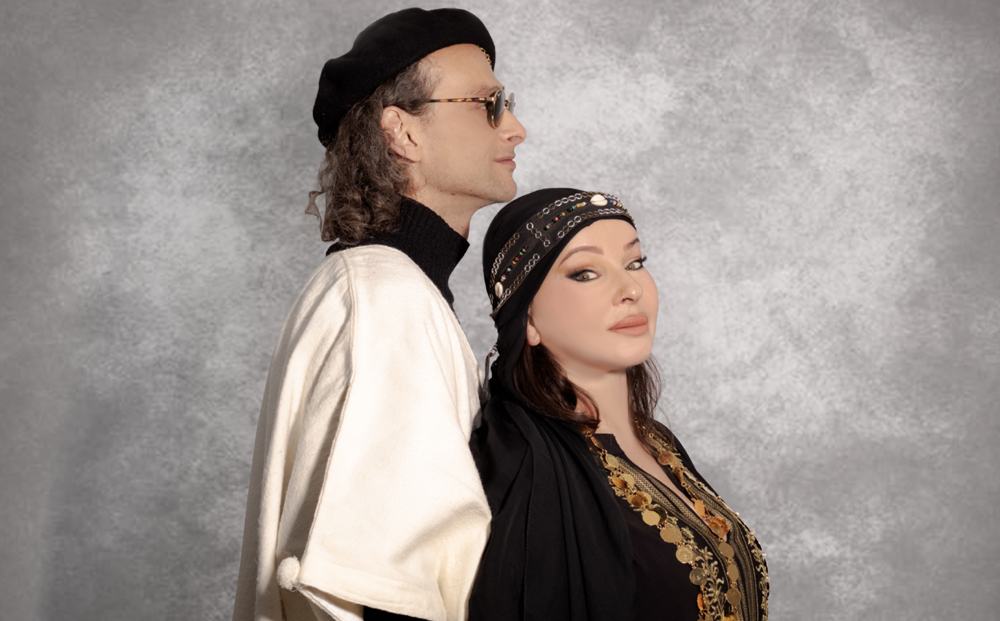
British-Egyptian singer Natacha Atlas has been one of the most distinctive voices in world music for decades. She started out with the group Transglobal Underground, with whom she still occasionally performs live, and Slovak audiences could recently see her alongside the band at the Uprising Festival. She became famous for her unique ability to blend traditional Arabic vocal techniques with Western electronic music, trip-hop, and jazz. In her latest project, created in collaboration with her long-time musical partner, producer, and composer Samy Bishai, she returns to the roots of electronic experimentation. The result is a fascinating record that takes listeners on a journey through alternative musical timelines.
A Musical Crossroads of Cultures and Genres
The album Parallel Universe (released under the Airfono label) is described as a bold reinterpretation of the musical intersection between East and West. While the album’s sonic textures heavily reference retro-futurism, analog electronics, and classic trip-hop, the overall spirit of the record is firmly anchored in the present. It offers a bold, contemporary vision of Arabic pop, filtered through the lens of uncompromising, experimental production.
Upon the release of the new album, the creators shared a powerful message that perfectly captures the essence of their experiment:
“Parallel Universe is a sonic exploration of ‘what if…’ – it is music from another reality, emerging at precisely the right moment.”
Trip hop, bass lines and oriental pop
Right from the opening tracks, such as the hypnotic Zar 12, this direction is clearly defined. Natacha Atlas once again proves that her melismatic, emotive vocals can effortlessly navigate any sonic environment. The track Unchanging Game brings the captivating atmosphere of Maghrebi trip-hop, blending deep basslines with melancholy melodies.
One of the album’s most striking moments is undoubtedly the closing track, Somoud. Here, the creators combine the ancient sound of the ney flute with modern, almost menacing trap bass. This genre cocktail creates a tense, cinematic atmosphere that demonstrates Bishai’s production genius and willingness to take risks. Other key tracks include the rhythmic Wana Leih, the energetic Dawsha, and the dreamy Bahlam Biyoum (Dream Of A Day).

The First Chapter of a New Era
The album title’s subtitle, “Volume 1,” indicates that the singer is opening a new artistic chapter, serving as the first installment in a planned series. The project was conceived as an exploration of parallel universes through bilingual songwriting, where Arabic and English naturally intertwine.
For loyal fans who have followed the singer since her early electronic days, this album is a welcome return to bolder roots after her recent years spent focusing primarily on acoustic jazz. However, Parallel Universe is not an exercise in nostalgia. It is an album for today – visionary, culturally engaged, and sonically immersive.
Natacha Atlas and Samy Bishai have created a piece of work that shatters barriers, proving that tradition and futurism do not have to stand in opposition. Parallel Universe is the perfect soundtrack for anyone searching for music without borders or prejudice. That is why this title became the ideal candidate for the “Album of the Week” feature in our broadcast on the Mixcloud platform.
NMR (photo: press Natacha Atlas)